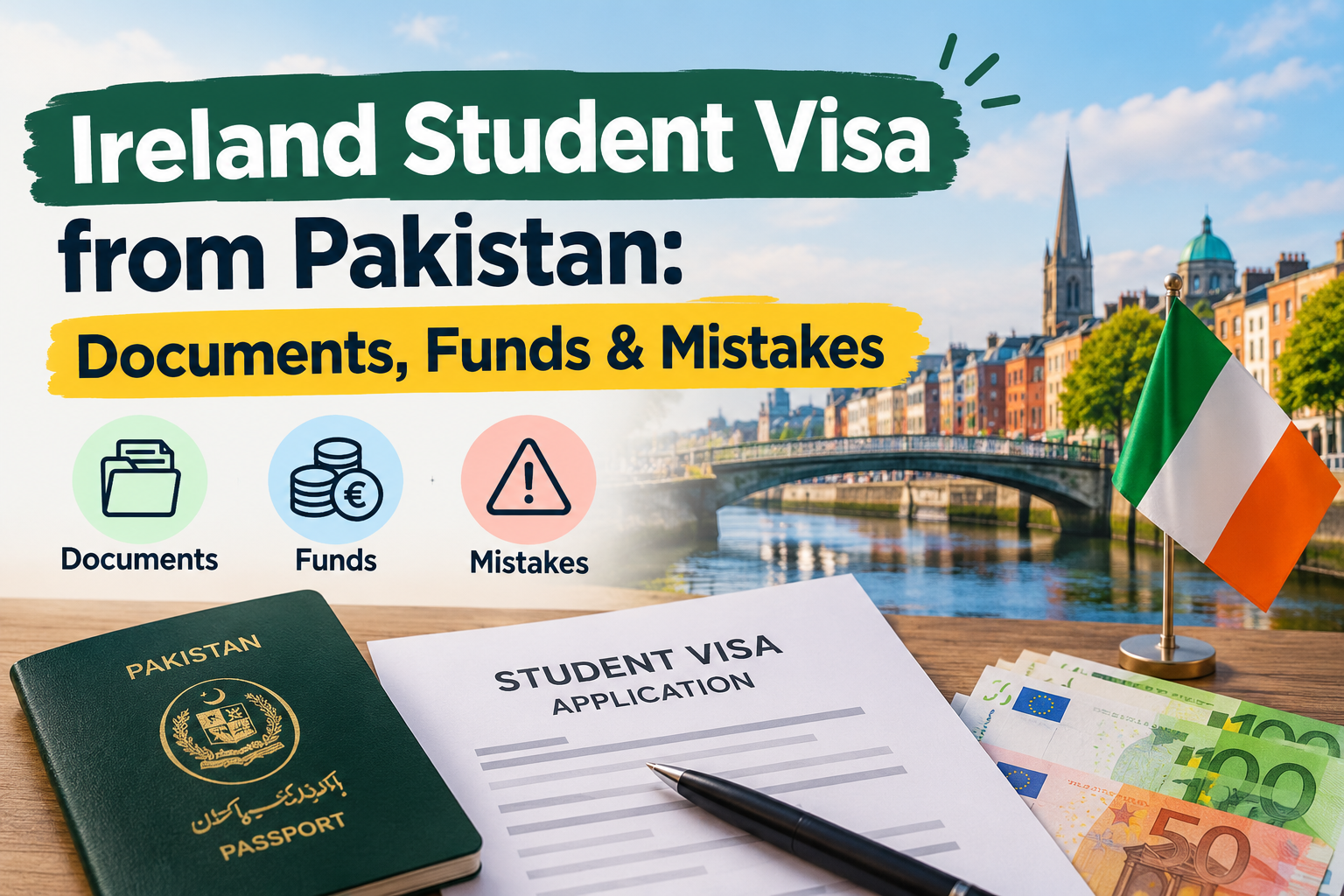
The documents, financial proof and common mistakes Pakistani students should understand before applying for an Irish study visa.
Many Pakistani students who want to study in Ireland get an offer letter, then freeze when they reach the visa stage. Which documents matter most? How should bank statements look? Why do some applicants with good grades still get refused? This guide walks you through the Ireland student visa for Pakistan applicants: the document checklist, how to present financial proof, and the mistakes we see most often.
Please note: immigration rules and figures change. Everything below should be confirmed on the official Irish Immigration Service website and with the Irish Embassy covering Pakistan before you apply.
How the Ireland student visa works for Pakistani students
As a Pakistani national, you need a visa before travelling to Ireland. For a full degree or any course longer than three months, this is usually a long-stay "D" study visa. A short course of three months or less falls under a different category.
The process generally runs like this:
- Get an offer from an Irish college for a course on the Interim List of Eligible Programmes (ILEP). This is the government's list of courses that qualify international students for a study visa. If your course is not on it, you cannot get a study visa for it.
- Pay your tuition fees (see the fee rules below).
- Complete the online application form through AVATS on the Irish Immigration Service website and print the summary sheet.
- Submit the summary sheet, your passport and supporting documents to the office named for applicants in Pakistan, following the latest instructions from the Irish Embassy.
Processing times vary through the year, and summer is busy. Apply as early as your offer and fee payment allow.
Ireland study visa requirements for Pakistani applicants: the document checklist
Your exact list may differ depending on your course and circumstances, but a typical application includes:
- Signed application letter explaining why you want to study this course in Ireland, your plans after graduating, and your commitment to follow visa conditions.
- Letter of acceptance from an ILEP-listed college.
- Proof of fee payment, usually a receipt from the college. It has been widely reported that you must pay the full fee if it is under €6,000, or at least €6,000 if it is higher. Confirm the current rule.
- English language result such as IELTS, PTE or another test your college accepts. Check the college's own requirement, as it varies.
- Academic documents: matric, intermediate and degree transcripts and certificates. Your college or the embassy may ask for these to be attested (for example by HEC for degrees or IBCC for school certificates), so check before submitting.
- Explanation of any gaps in your education, with evidence such as employment letters.
- Private medical insurance for your time in Ireland.
- Financial evidence (covered in detail below).
- Passport with sufficient validity (commonly stated as at least 12 months) and copies of previous passports.
- Visa history, including any refusals from any country.
Any document not in English, such as an Urdu-only record, will need a certified translation.
Ireland visa bank statement: how to show financial proof from Pakistan
Financial evidence is where many Pakistani applications succeed or fail. The visa officer wants to see that you can cover your living costs without relying on unauthorised work or public funds.
How much money you need
For years, the figure commonly cited for living costs was €10,000 per year of study, and there have been reports of this rising to around €12,000. Check the current amount on the Irish Immigration Service website before you plan your finances, because this is exactly the kind of figure that changes. This is in addition to your tuition fees.
What good bank statements look like
- Statements usually covering the six months before you apply, on bank letterhead or stamped and signed by the branch.
- A steady history of income and savings, not a balance that appears overnight.
- A clear, documented source for any large deposit, such as a property sale deed, gift deed, salary slips or business records.
If a parent or relative is sponsoring you
Most Pakistani students are sponsored by family. In that case, include:
- A signed sponsorship letter stating the amount and commitment.
- Proof of relationship, such as a NADRA Family Registration Certificate (FRC) or birth certificate.
- Proof of the sponsor's income: salary slips, employer letter, business registration, and FBR tax returns or NTN records.
- The sponsor's bank statements covering the same period.
A sponsor whose declared income clearly does not match their bank balance will raise questions. Consistency across documents matters more than a large number.
Visa fees and other costs to budget for
Beyond tuition and living funds, plan for:
- The visa application fee, historically €60 for a single-entry visa, sometimes payable in PKR at the current rate.
- Service charges from the visa application centre, if applicable, which are separate from the government fee.
- Immigration registration (IRP) after you arrive in Ireland, which has been €300.
- Medical insurance, flights, initial accommodation deposits and document attestation costs in Pakistan.
Students on a study permission (Stamp 2) have generally been allowed to work part-time, commonly cited as 20 hours a week in term and 40 hours in set holiday periods. Treat this as a supplement, not a way to fund your studies; your financial proof must stand on its own.
Common mistakes that lead to refusals
Most refusals we see are avoidable. Watch out for:
- Unexplained lump-sum deposits. A sudden large credit without paperwork looks like borrowed money placed to pass the check.
- A course that doesn't fit your background. Moving from a BBA to an unrelated diploma, with no explanation, makes your plans look unconvincing.
- Unexplained study gaps. Gaps are fine if you show what you did: work, family responsibilities, illness.
- Hiding previous refusals. Failing to disclose a refusal from any country can be treated far more seriously than the refusal itself.
- Partial fee payment. Paying less than the required amount is a straightforward reason for refusal.
- A course not on ILEP. Always check the list yourself.
- Missing translations or attestations.
- A generic statement of purpose. Copied templates are easy to spot. Write about your own goals, why this course, why Ireland and how it connects to your future in Pakistan or elsewhere.
A word on agents: be wary of anyone who offers to "arrange" bank balances, fake experience letters or a guaranteed visa. Fraudulent documents can lead to refusal and may affect future applications. No honest consultant can guarantee a visa.
Key takeaways
- Only courses on the ILEP qualify for an Irish study visa, so check before you accept an offer.
- Financial proof should be consistent, well documented and built up over months, not added at the last minute.
- Sponsors need to show relationship, income and tax records, not just a bank balance.
- Be fully honest about study gaps and previous refusals.
- Confirm every fee and financial threshold on official Irish government sources before applying.
Frequently asked questions
Can my uncle sponsor my studies in Ireland?
Sponsorship by relatives other than parents is sometimes accepted, but you will need clear proof of the relationship, the sponsor's income and a convincing reason for their support. Parents are usually the most straightforward sponsors.
Is a study gap a problem for an Ireland student visa?
Not on its own. What causes problems is an unexplained gap. Provide a short written explanation with evidence, such as employment letters or medical records.
Do I need IELTS, or can I use another test?
It depends on the college. Many Irish institutions accept several tests, and some may accept other evidence. Check the requirement on your college's admissions page and make sure it satisfies visa guidance too.
If I am refused, can I appeal?
Ireland has generally allowed appeals of study visa refusals within a set period, and the refusal letter explains the reasons. Read it carefully, fix the actual problem and get advice before deciding whether to appeal or reapply.
Every application is different, and small details in your documents can make a real difference. If you would like someone to look over your plans, your finances or your statement of purpose, you are welcome to speak with a counsellor at Jiva Consultings. We will give you an honest view of where you stand.
Hamza
Published October 6, 2026